
Shawn McNulty
Acrylic on Cradled Board
10×10”
2025
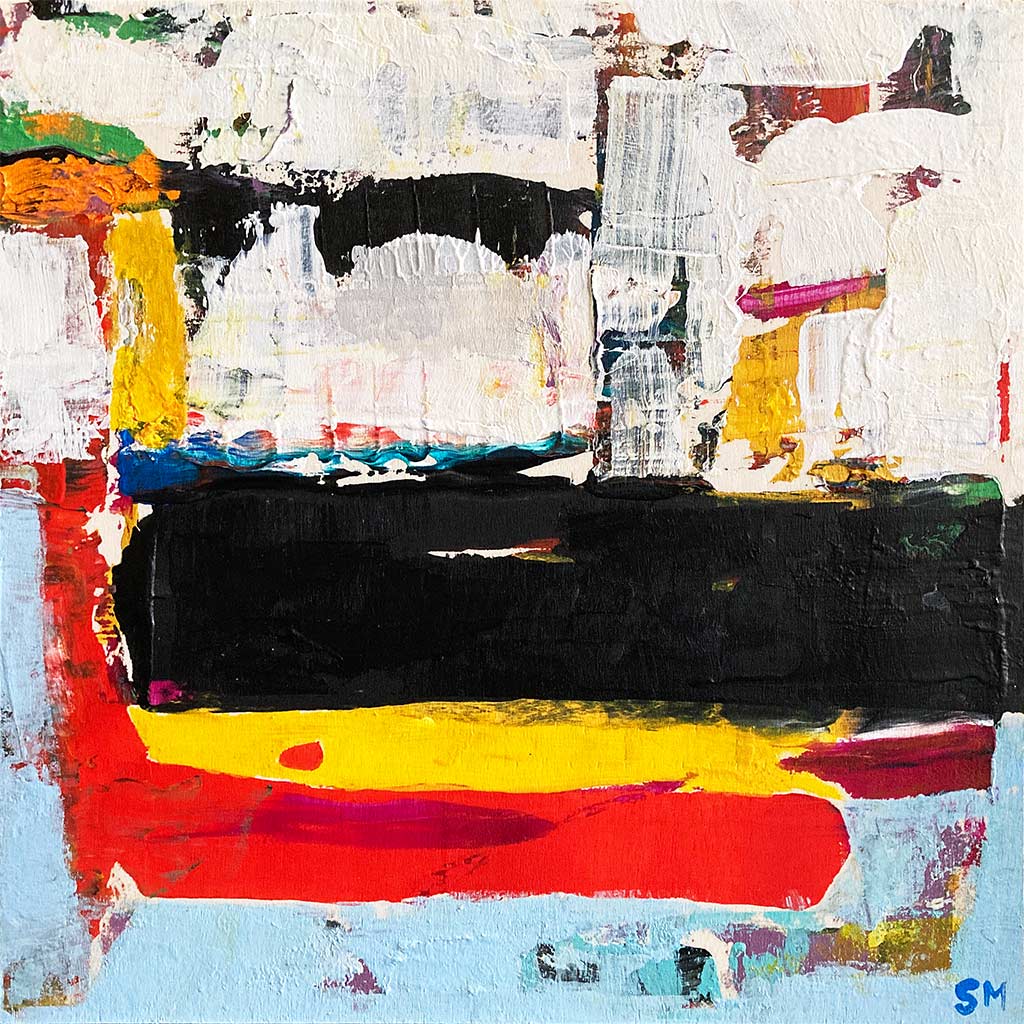
Obsidian is an original abstract painting on cradled board by visual artist Shawn McNulty. This painting is is 1″ deep with pine edges, and ready to hang with wire on the back.
The Deep Mystery of Obsidian
Obsidian is one of those stones that feels like it carries secrets. You hold it in your hand and it’s smooth, cool, and impossibly dark — a piece of frozen lava that somehow managed to keep the heat and drama of a volcano locked inside. There’s a strange duality to it: sharp yet calming, ancient yet modern, natural yet almost otherworldly. That mix of contrasts is what inspired the colorful abstract painting Obsidian, which captures the stone’s spirit with a bold black horizontal stroke slicing through a vibrant field of color — a visual echo of how obsidian itself cuts through light and time.
At first glance, obsidian might look like just a shiny black rock, but it’s far from ordinary. It forms when molten lava cools so quickly that it doesn’t have time to crystallize. Instead of forming the typical rough, grainy structure of most rocks, it becomes glass — volcanic glass. That rapid cooling freezes the chaos of an eruption in an instant, leaving behind a sleek, reflective surface that almost looks man-made. In a way, it’s nature’s own minimalist sculpture.
If you look closely under the light, you’ll notice that not all obsidian is pure black. Some have subtle hints of green, brown, or even purple. Others shimmer with iridescent colors known as “rainbow obsidian,” where microscopic mineral inclusions reflect light like oil on water. It’s that play of color beneath the surface that Obsidian the painting captures so beautifully — splashes of deep blue, amber, and crimson swirling behind a commanding black stroke that anchors everything in place. It’s not just a painting; it’s an interpretation of how something seemingly dark can still contain endless depth.
A Stone of Fire and Shadow
What makes obsidian fascinating is its fiery origin. It starts as molten rock — liquid fire erupting from deep within the Earth. Then, suddenly, it cools and solidifies into stillness. That contrast between chaos and calm, between violence and serenity, is what gives obsidian its character. It’s literally born from destruction yet ends up polished and beautiful.
When you run your fingers along its glassy surface, you’re touching the cooled memory of a volcano. It’s easy to imagine the lava flowing, glowing orange and red, then abruptly freezing into this silent black form. That transformation — from motion to stillness — mirrors the strong horizontal brushstroke in the painting Obsidian, where motion meets control, and color gives way to shadow.
Throughout history, humans have been drawn to this strange stone. Ancient cultures valued it not just for its beauty but for its utility. Because it breaks with sharp edges, obsidian was one of the earliest materials used for cutting tools and weapons. Obsidian blades, even today, can be sharper than surgical steel — thin enough to slice at the molecular level. There’s something poetic about that: a dark, glassy rock capable of both artistry and precision. In art, that same duality shows up as bold simplicity — a single black line that feels like both a cut and a connection.
Symbolism and Meaning
Spiritually and symbolically, obsidian is often associated with protection, grounding, and truth. It’s thought to absorb negative energy and reveal hidden emotions. Whether or not you believe in crystals and their metaphysical properties, there’s no denying that obsidian feels powerful. Its reflective surface can almost act like a mirror, both literally and metaphorically, forcing you to look inward.
That reflective quality finds its way into the painting Obsidian too. Beneath the wide black stroke, color bleeds and blends in organic ways — like emotional layers half-buried under darkness. The black isn’t oppressive; it’s grounding, a reminder that even in the chaos of color, something solid holds everything together.
The painting, much like the stone, suggests that darkness doesn’t have to mean emptiness. Sometimes, it’s where the light is born from.
The Allure of Simplicity
There’s a quiet modernity to obsidian that feels timeless. It doesn’t need sparkle or ornamentation to impress — it’s confident in its simplicity. That’s part of why it’s become a favorite material for jewelry and home décor. A polished obsidian pendant catches the light in a way that’s subtle but captivating. It doesn’t shout; it hums.
The same could be said of the painting Obsidian. The bold black line stretches confidently across the canvas — assertive yet calm — while the surrounding colors pulse with energy, as if trying to break free. It’s a visual metaphor for control and release, the same dynamic found in the formation of the stone itself.
In many ways, both the stone and the painting are studies in restraint. They prove that you don’t need complexity to create depth. You just need contrast — black against color, stillness against motion, simplicity against chaos. The power lies in the tension between opposites.
A Window into the Earth — and Ourselves
What’s amazing about obsidian is that it’s a direct window into the Earth’s interior. Most rocks form slowly, layer by layer, but obsidian captures a geological event in real time. It’s like hitting pause on a volcanic eruption. When you hold a piece of it, you’re holding a frozen moment from deep time — a millisecond of planetary creation made tangible.
That’s why Obsidian the painting feels so connected to nature despite its abstract form. It channels that same moment of transformation — the instant when heat becomes stillness, when fluid becomes form. The black stroke across the canvas can be seen as the cooled crust of lava, while the colors underneath suggest the molten life still moving below. It’s not just inspired by a stone; it’s a portrait of geological emotion.
The Beauty of the Depths
Obsidian reminds us that beauty doesn’t always come from brightness. Sometimes, it comes from depth, from contrast, from the quiet shimmer hiding inside darkness. It’s both an end and a beginning — the aftermath of chaos that still carries a trace of fire.
The painting Obsidian captures that essence perfectly. The bold black horizontal stroke doesn’t dominate the canvas; it balances it. It’s a line that divides and unites, much like the horizon between sky and earth, or the thin crust separating the molten core from the cool surface above. Beneath the black, color hums softly — a reminder that even in shadow, there’s always energy waiting to emerge.
In the end, both the stone and the painting tell the same story: that strength and serenity can come from darkness, and that sometimes the most beautiful things are born from fire.






Reviews
There are no reviews yet.