
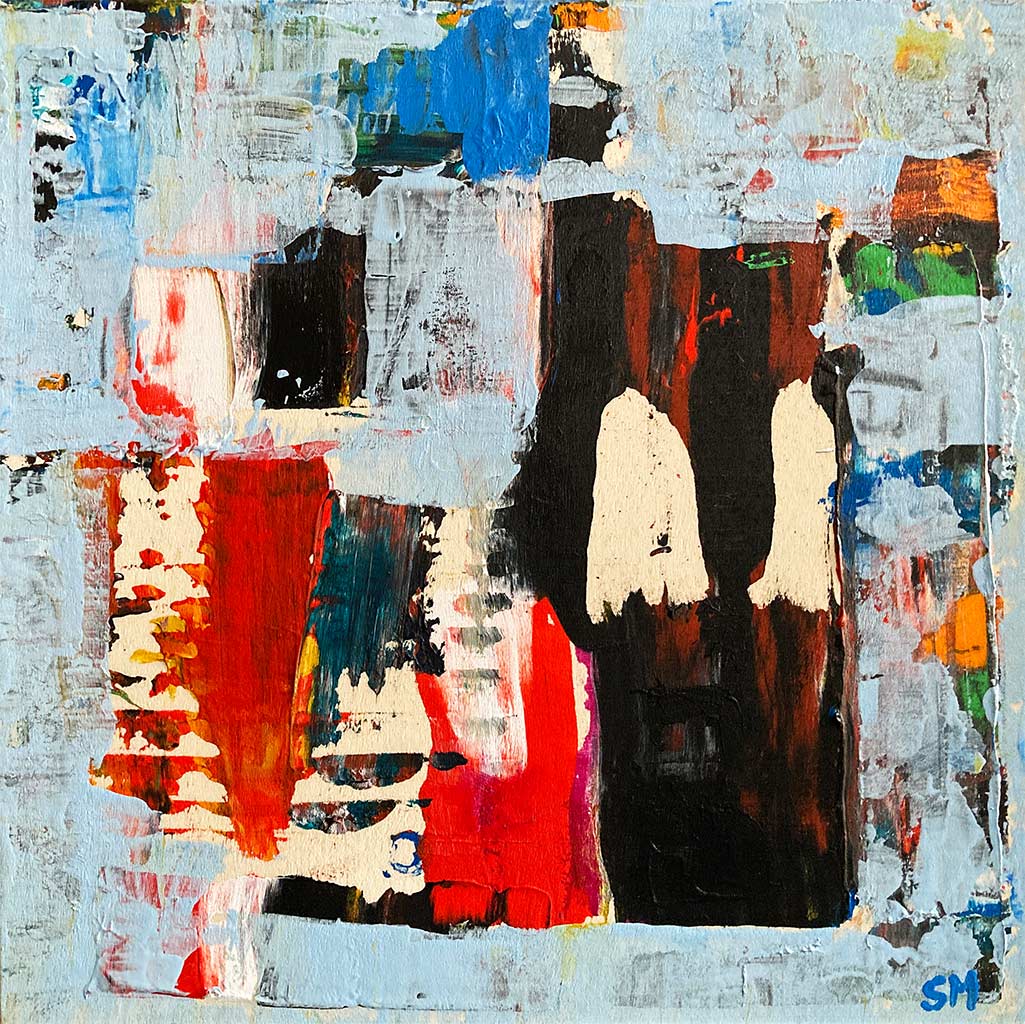

Shawn McNulty
Acrylic on Cradled Board
10×10”
2025
Zephyr is an original abstract painting on cradled board by visual artist Shawn McNulty. This painting is is 1″ deep with pine edges, and ready to hang with wire on the back.
The Story of the California Zephyr and a Painting Called Zephyr
There’s something timeless about watching the landscape roll by from a train window—the rhythm, the hum, and the ever-changing scenery. Among American train routes, few are as legendary as the California Zephyr, a line that has carried travelers across the heart of the country for more than seven decades. It’s a journey that stitches together plains, mountains, and deserts, and it’s inspired countless artists, writers, and dreamers along the way.
One such inspiration came to life in a light blue abstract painting titled Zephyr. The work captures the feeling of motion—the blur of color, the calm of open skies, and the freedom of travel. Just like the train that inspired it, Zephyr is about movement and wonder, about the beauty of crossing landscapes both external and internal.
The Birth of the California Zephyr
The story begins in 1949, when the original California Zephyr made its maiden run. It was a collaboration between three railroads: the Chicago, Burlington & Quincy Railroad (CB&Q), the Denver & Rio Grande Western (D&RGW), and the Western Pacific (WP). Together, they created a route that stretched from Chicago to Oakland, linking the Midwest to the West Coast through some of the most dramatic scenery in the United States.
From the start, it wasn’t just a train—it was an experience. The Zephyr’s silver streamliner cars gleamed under the sun, reflecting the optimism of postwar America. Inside, passengers enjoyed dome cars with panoramic glass ceilings, elegant dining cars, and sleeper berths that felt luxurious by mid-century standards. It was designed to compete not only with other trains but with the rising popularity of air travel.
The original Zephyr route quickly earned a reputation as the most beautiful train ride in America. It wound through the Rocky Mountains, crossed the deserts of Nevada, and climbed the Sierra Nevada before descending toward the Pacific. Passengers could watch the country unfold before them, from farmland to alpine forests to sun-bleached canyon walls.
“Vista-Dome” Views and the Golden Age of Train Travel
The California Zephyr was famous for its Vista-Dome cars—those rounded glass domes that gave passengers a 360-degree view of the world outside. People would spend hours sitting in those domes, camera in hand, as the train passed landmarks like the Colorado River canyons or the snowy peaks near Donner Pass.
This was the golden age of passenger rail travel in the U.S., when trains symbolized sophistication and adventure. Ads for the Zephyr promised “the most talked-about train in America” and highlighted the “land of grandeur” along its route. It was more than transportation—it was a rolling vacation.
Hard Times and a New Beginning
But by the 1960s, the romance of train travel was fading. Cars and airplanes took over, and one by one, the private railroads began cutting passenger service. The original California Zephyr made its final run in March 1970, a moment that marked the end of an era.
Then, just a year later, Amtrak was formed—a government-supported company created to save what was left of passenger train travel in the U.S. In 1983, Amtrak revived the Zephyr name, merging parts of the old route with new sections, and the California Zephyr was reborn.
Today, the Amtrak Zephyr runs between Chicago and Emeryville, California, near San Francisco. The trip takes about 51 hours and covers roughly 2,400 miles—still one of the longest and most scenic train rides in North America.
The Modern Zephyr Experience
Modern travelers still speak about the California Zephyr with a kind of reverence. It’s not about speed (the route is famously slow by design), but about immersion. You can board in the flat farmlands of Illinois, fall asleep crossing Nebraska, and wake up to the rising sun over the Rockies. The route passes through Denver, Glenwood Springs, Salt Lake City, Reno, and the Sierra Nevada before reaching California.
For many, it’s a chance to unplug from the fast pace of daily life and just watch the world go by. The observation car, with its wide windows and comfortable seats, has become a kind of mobile art studio and meditation space. Travelers journal, sketch, read, or just stare out the window for hours.
The Painting Zephyr
The abstract painting Zephyr captures that essence of slow, graceful motion. With light blue tones layered over soft whites and silvers, it evokes the colors of sky and metal, of reflection and distance. The brushstrokes seem to drift across the canvas like clouds over mountains or waves of light rippling through a train window.
Rather than depicting the train itself, Zephyr expresses the feeling of travel—the calm rush of landscapes passing by, the blur of rivers and plains blending into one long dream. It’s a painting that seems to move even while standing still, much like the way a long train ride can feel suspended between departure and arrival.
A Symbol of American Journey
The California Zephyr has become a symbol of exploration and endurance. For decades, it’s represented the idea that the journey itself matters just as much as the destination. Artists, photographers, and filmmakers have used it as a backdrop to tell stories about wanderlust and rediscovery.
From the windows of the Zephyr, passengers see some of the most diverse terrain in the country—towering cliffs, endless deserts, and rolling farmland. It’s a moving cross-section of America, a reminder of how vast and varied the landscape is. The train connects cities and small towns, old stations and new travelers, linking generations in motion.
Motion as Meditation
There’s something meditative about both train travel and abstract painting. Each asks you to slow down, to observe rather than rush. The painting Zephyr channels that same patience, inviting viewers to get lost in its layers, much like the way you might lose track of time watching scenery slide past your window.
Together, the California Zephyr and Zephyr the painting share a kindred spirit. They’re both about motion and reflection—moving through space, through memory, and through emotion. They remind us that sometimes beauty isn’t in where you’re going, but in what you see along the way.





Reviews
There are no reviews yet.