
Drawing animals can be fun and relaxing. The cheetah is a great subject because it’s full of energy and grace. In this guide, I’ll show you how to draw a cheetah in four easy steps. You don’t need to be an artist — just grab a pencil, some paper, and let’s begin.
I’ll also reference my abstract painting “Cheetah.” It’s a bold mix of turquoise, orange, and green shapes that capture the animal’s speed and wild beauty. My painting is expressionistic, full of movement and color, but your cheetah drawing will be more realistic. Think of it as two sides of the same coin — one emotional, one visual.
Step 1: Start with Basic Shapes
Let’s begin simple. Every drawing starts with shapes.
Draw a large oval for the cheetah’s body. Place it slightly tilted so it looks ready to move. Next, draw a smaller circle for the head. Connect the two shapes with a short curved line for the neck.
Now, sketch four thin lines for the legs. Add small ovals at the ends for paws. Finally, draw a long, curved line coming from the back — that’s your cheetah’s tail. Don’t worry about perfect lines. Keep it loose and light.

At this stage, your drawing looks like a stick figure. That’s totally fine. You’re setting the foundation. Later, we’ll add muscles, spots, and life.
In my painting “Cheetah,” I used energetic brushstrokes to create flow. Your shapes do the same — they build motion before the details arrive.
Step 2: Outline the Body and Head
Next, connect those shapes to form your cheetah’s outline.
Use smooth, curved lines to shape the body. Make the back long and sleek. Cheetahs are built for speed, so avoid bulky forms. Add gentle curves where the legs bend.
Shape the head by connecting the circle’s sides to a small pointed muzzle. Draw two small ears on top — rounded triangles work well. Lightly sketch almond-shaped eyes. Don’t forget a small nose and mouth line.
Now, go over your lines with slightly darker strokes. You’ll start to see the cheetah take form.

At this point, it might look more like a cat. That’s okay. Cheetahs are slender cats, after all. Keep refining the body’s curves until it looks agile and ready to run.
When I created “Cheetah,” I imagined movement through color. The turquoise represents energy, while orange shows wild freedom. In your drawing, the curve of the body tells the same story — the beauty of motion.
Step 3: Add Spots and Tail Details
Here’s where your cheetah comes alive. Cheetahs are famous for their black spots.
Look at your drawing. Fill the body with small, round dots. Spread them evenly, but not in perfect patterns. Nature isn’t symmetrical.
Make the tail stand out too. Draw small black rings near the tip. Leave the end part dark or shaded. This creates a realistic finish.
Add some muscle lines along the legs and chest. Use short, light strokes for fur texture. Don’t overdo it — simplicity works best.
Lastly, darken the eyes and add the cheetah’s unique tear lines. These are dark streaks running from the eyes down to the mouth. They make the face expressive and true to life.
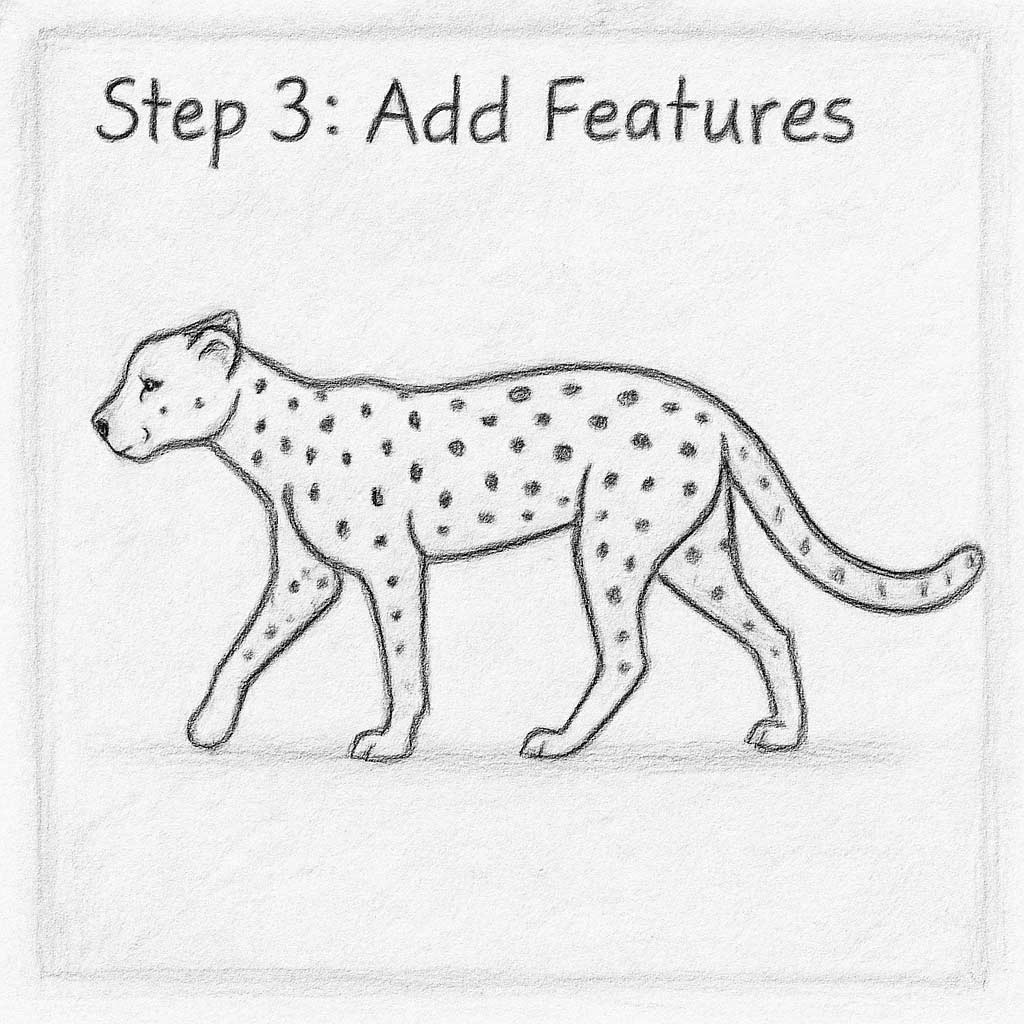
In my abstract version, I used bursts of color instead of spots. The orange and turquoise shapes represent the cheetah’s energy. Your spots do the same job — they express life and motion.
Step 4: Add Color and Shading
Now, it’s time to make your cheetah shine.
Use colored pencils, markers, or paints. For the image demo, I’m keeping it black and white, so you can use your imagination on color possibilites. Start with golden yellow or light tan for the body. Add deeper shades around the legs, chest, and belly to show depth.
Color the spots black and shade the face lightly. The nose should be dark gray or black. Leave small white highlights in the eyes — this adds sparkle.

If you want, draw a background. Cheetahs live in open grasslands, so you can add some tall grass, trees, or a blue sky. Or keep it simple with a clean background to focus on the animal.
Work slowly, layer your colors, and blend gently. You’ll notice your cheetah start to look real and dynamic.


My painting “Cheetah” bursts with warm tones and movement. When you color your drawing, think of emotion too — the warmth of the sun, the speed of the animal. Art is more than copying; it’s about feeling.
Final Touches
Look over your drawing. Erase any unnecessary lines. Darken the outlines that matter most.
Add more spots if needed. Maybe enhance the eyes for extra personality. Each cheetah drawing is unique — don’t worry if yours looks a bit different.
You can also experiment with artistic touches. Outline the body in a bold color like orange or blue, inspired by abstract expressionism. That’s a fun nod to “Cheetah,” the painting.
Take a moment to admire your work. You’ve gone from simple shapes to a complete animal. That’s real progress. And just like an abstract artist, you’ve learned how to capture motion, shape, and emotion all at once.
Tips for Future Drawings
Keep practicing. The more cheetahs you draw, the more confident you’ll become.
Try sketching cheetahs from different angles. Study photos for reference. Watch how they move. Notice their lean bodies and alert faces.
You can also simplify your drawing into a cartoon style or make it more detailed. Art grows with you.
Mix media too — try pastels, markers, or acrylics.
If you feel inspired by abstract art, create your own colorful version. Replace the spots with brushstrokes or bright shapes. Use unexpected colors like teal, pink, or orange. That’s how expressionism and realism meet — through creativity.
Conclusion
Drawing a cheetah in four steps is simple when you break it down. You start with shapes, build structure, add spots, and finish with color. Every step brings you closer to the wild spirit of this amazing animal.
My painting “Cheetah” celebrates that same energy in a different form. Through abstract layers of turquoise and orange, it expresses motion rather than detail. Your drawing shows the other side — the beauty of the cheetah’s form.
Both paths lead to art that feels alive.
So, grab your pencil and let your imagination run fast — just like a cheetah.