


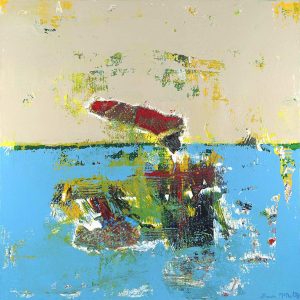
Shawn McNulty
Acrylic on Cradled Board
10×10”
2025
Amphora is an original abstract painting on cradled board by visual artist Shawn McNulty. This painting is is 1″ deep with pine edges, and ready to hang with wire on the back.
The Ancient Elegance of Amphora Pottery
There’s something undeniably beautiful about an amphora — that tall, two-handled vessel with a slender neck and a graceful, curving body that seems almost human in form. Even if you’ve never studied ancient art, chances are you’ve seen one: in a museum, a movie about ancient Greece, or maybe even as a decorative piece in someone’s home. The amphora is one of those timeless shapes that connects us directly to history — not just as an object, but as a symbol of how people once lived, traded, and expressed beauty through everyday things.
At its core, an amphora was a storage container. In ancient times, people used them to transport everything from wine and olive oil to grains and perfumes. But unlike the plastic jugs and jars we rely on today, amphorae were crafted with artistry and purpose. Each one was hand-shaped from clay, fired in a kiln, and often painted with intricate scenes of gods, warriors, or daily life. These vessels weren’t just utilitarian — they were the perfect fusion of function and art.
A Vessel With a Story
The word “amphora” comes from the Greek amphi (meaning “on both sides”) and phoreus (meaning “to carry”). The name says it all — it’s a vessel designed to be lifted and carried by its two elegant handles. Most amphorae tapered to a point at the bottom, which allowed them to be set into racks or sand for stability, especially on ships. Merchants used them as the ancient equivalent of shipping containers, neatly stacked in the holds of trading vessels crossing the Mediterranean.
Imagine rows of them — thousands at a time — filled with oil from Crete, wine from Italy, or honey from Rhodes. Each amphora was marked with a symbol or inscription identifying its contents and place of origin. Even broken shards found by archaeologists today can tell a story of trade routes, craftsmanship, and cultural exchange.
But amphorae were more than just storage. They were also part of life’s rituals. In ancient Greece, they were used in weddings, funerals, and athletic celebrations. Victorious athletes in the Panathenaic Games — the precursor to the Olympics — would receive large amphorae filled with olive oil as prizes. Those amphorae were decorated with images of Athena, the goddess of wisdom and war, on one side, and scenes of athletic competition on the other. The vessels weren’t just trophies; they were a celebration of strength, skill, and divine favor.
Form Meets Function
Part of what makes amphora pottery so captivating is how perfectly balanced its design is. The long, narrow neck helped control the pour, while the rounded body provided volume and strength. The twin handles weren’t just practical — they also gave the vessel symmetry and grace. The pointed base, though impractical for setting on flat surfaces, made perfect sense for its original use: these vessels were designed to be placed upright in stands, racks, or even embedded in the sand on ships.
Over time, the amphora’s shape evolved depending on the culture and its needs. Greek amphorae tended to be slender and elegant, with carefully painted black-figure or red-figure designs. Roman versions were plainer and more standardized, mass-produced for the booming trade empire. Even so, each culture added its own touch — the Greek versions often told mythological stories, while later ones leaned more utilitarian but still carried traces of beauty in their proportions.
It’s no wonder modern artists and potters still draw inspiration from the amphora’s silhouette. Its balance of strength and softness, geometry and grace, feels timeless. You can spot echoes of its form in everything from wine bottles to modern vases — proof that good design never really goes out of style.
Painted Stories on Clay
One of the most fascinating aspects of amphora pottery is the way it served as a canvas for storytelling. The Greeks, especially, mastered this art. Using techniques like the black-figure and red-figure styles, artists would paint detailed scenes directly onto the clay before firing.
In black-figure pottery, the figures were painted in a glossy black slip that turned dark in the kiln, while the background remained the reddish color of the clay. Later, in the red-figure technique, the process was reversed — the background became dark, and the figures were left the color of the clay, allowing for more detail and realism.
These amphorae depicted everything from heroic battles and mythological tales to quiet scenes of daily life — musicians playing lyres, women fetching water, or warriors bidding farewell before battle. They weren’t just decorations; they were visual records of how people saw their world.
Amphorae in the Modern Imagination
Today, when you see an amphora in a museum, it’s easy to be struck by its age — some are over 2,500 years old — but what’s even more impressive is how familiar it feels. The curves, the balance, the craftsmanship — it’s as if the potter who made it understood beauty in the same way we still do. There’s something universal about that.
Artists continue to reinterpret the amphora form in new ways. Some create minimalist versions in glass or metal; others, like abstract painters and sculptors, use the amphora’s shape as a metaphor for containment — of time, memory, or emotion. The vessel becomes a symbol: holding not olive oil or wine, but human experience itself.
A Living Legacy
What’s most remarkable about amphora pottery is how it bridges the gap between the ancient and the modern. It’s easy to see it as a relic, something from a distant past — yet its design still influences art, architecture, and everyday objects today. The amphora reminds us that beauty and utility don’t have to be separate ideas. A simple container for storing goods became a lasting icon of craftsmanship, culture, and creativity.
In a way, the amphora represents the human story: practical yet expressive, rooted in purpose but reaching toward art. It carried the essentials of life — oil, wine, water — but it also carried stories, myths, and the marks of the hands that made it.
So next time you see an amphora, whether it’s behind glass in a museum or reimagined in a modern art studio, take a moment to appreciate its quiet genius. Beneath its smooth curves and delicate handles lies thousands of years of history — a reminder that even the simplest shapes can hold the deepest meaning.







Reviews
There are no reviews yet.