
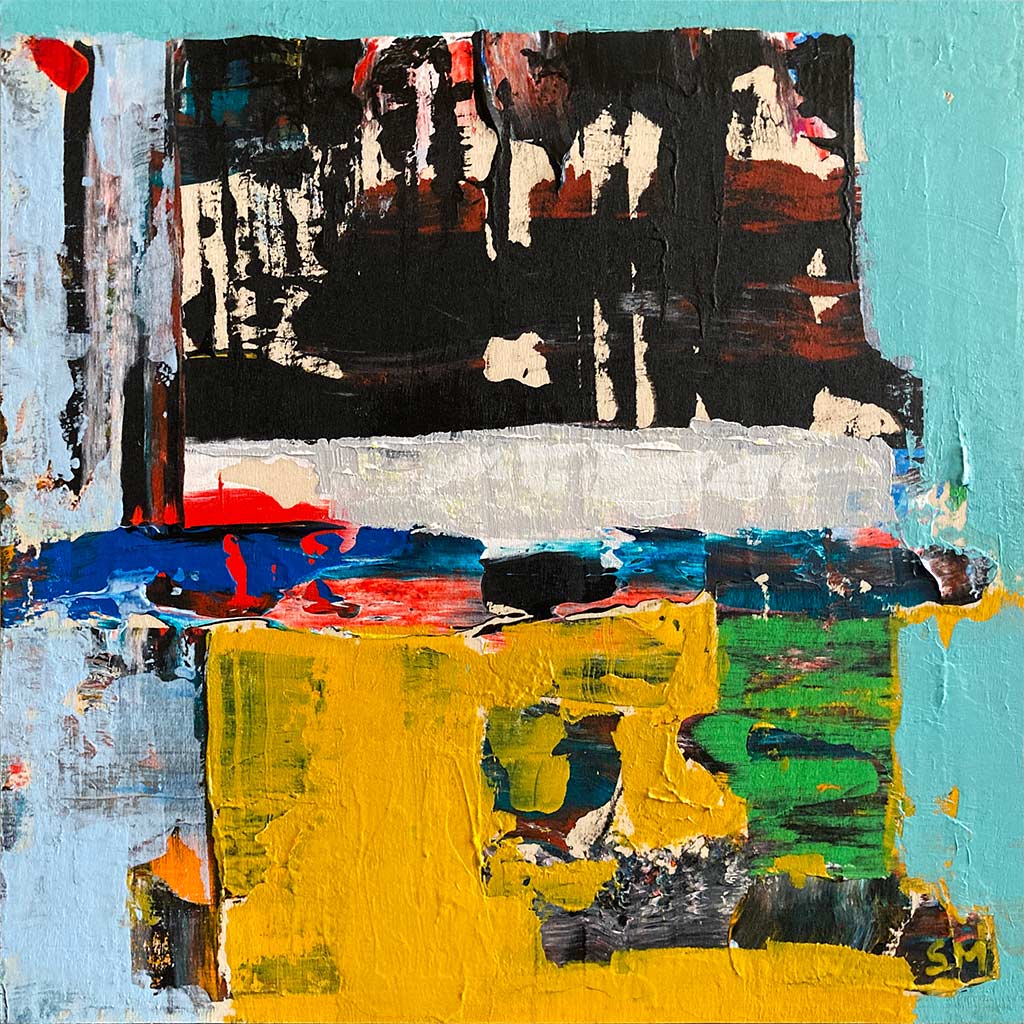

Shawn McNulty
Acrylic on Cradled Board
10×10”
2025
Fusion is an original abstract painting on cradled board by visual artist Shawn McNulty. This painting is is 1″ deep with pine edges, and ready to hang with wire on the back.
The Brilliant Chaos of Nuclear Fusion
There’s something both poetic and terrifying about the idea of nuclear fusion — the same process that powers the sun, quietly humming away 93 million miles from us, creating light and warmth that makes life possible. At its core, fusion is a story of opposites colliding: immense heat and crushing pressure working together to turn tiny particles into energy. If you could see it with your eyes, it might look like a glowing dance of light — a swirling explosion of blue, yellow, and black energy — something not unlike a colorful abstract painting titled Fusion Bloom, with light blue streaks representing plasma’s flow, yellow bursts symbolizing radiant heat, and deep black patches hinting at the mystery and chaos within.
Nuclear fusion has been called the “holy grail” of energy science for decades, and for good reason. It promises nearly limitless clean energy without the radioactive waste or meltdown risk of traditional nuclear fission. But to truly appreciate how it works, we have to zoom in — all the way down to the atomic level, where the drama unfolds.
The Science of Colliding Suns
In simple terms, fusion is what happens when two atomic nuclei combine to form a heavier nucleus. This merging releases an enormous amount of energy, following Einstein’s famous equation, E=mc². It’s the same reaction happening in stars, where hydrogen atoms fuse under crushing gravity to create helium — and in the process, unleash staggering amounts of light and heat.
Here on Earth, we don’t have that kind of gravitational pull. So scientists try to recreate those stellar conditions using extreme temperature and pressure. Think hundreds of millions of degrees — hot enough that atoms lose their electrons and become a sea of charged particles known as plasma. Plasma is a wild, unpredictable state of matter, full of motion and energy. You can almost imagine it as a living thing, swirling and flashing in hues of light blue and gold, like the vibrant tones in Fusion Bloom — a visual metaphor for both creation and chaos.
In this state, hydrogen isotopes such as deuterium and tritium can finally overcome their natural repulsion. Normally, atomic nuclei hate getting close to each other because they’re both positively charged. But under the right conditions — incredible heat, immense pressure — they smash together, fuse, and release energy in the form of high-speed neutrons and light. It’s like cosmic alchemy, where the smallest building blocks of the universe collide and transform into something greater.
A Star in a Bottle
The phrase “building a star in a bottle” gets thrown around a lot when describing fusion research, and it’s not an exaggeration. The goal is literally to contain and control a miniature sun here on Earth. The main challenge? The plasma must be kept stable long enough for fusion to happen — and at temperatures hotter than the core of the sun.
That’s where magnetic confinement comes in. The leading design, called a tokamak, looks like a futuristic metal donut. Inside, powerful magnetic fields twist and swirl the plasma, preventing it from touching the reactor walls (which would instantly cool it and ruin the reaction). It’s a constant balancing act — keeping something as wild and energetic as a star perfectly suspended in an invisible cage.
If you could peek inside, it would look like a living painting — shimmering light blue plasma, streaks of golden heat, and dark magnetic shadows curling around it. That’s Fusion Bloom brought to life: controlled chaos, radiant energy swirling against darkness.
From Dreams to Reality
For decades, fusion energy has hovered just over the horizon — always “thirty years away.” The technology is incredibly complex and expensive. Every tiny step forward feels monumental. But recently, progress has accelerated. Facilities like the ITER project in France and the National Ignition Facility in California have achieved record levels of energy gain, bringing the dream closer to reality.
In late 2022, scientists achieved a major milestone called “ignition,” where the energy released from a fusion reaction exceeded the energy used to trigger it. That doesn’t mean we can power cities yet, but it’s proof that the physics works. The challenge now is making it efficient, reliable, and continuous — turning a flash of fusion into a steady, usable energy source.
Private companies are joining the race too, experimenting with smaller, faster designs. It’s starting to feel like the early days of aviation — daring, experimental, full of hope and trial. Someday, if these efforts succeed, we could have fusion reactors that power the world cleanly, endlessly, and safely. Imagine cities lit not by fossil fuels or fission plants, but by the same process that makes the sun shine.
The Art of Creation
There’s something deeply artistic about fusion. It’s not just physics; it’s the creation of light itself. That’s why Fusion Bloom, with its explosion of light blue plasma tones, bold yellow arcs, and deep black streaks, feels like the perfect visual echo. The painting captures the tension between creation and destruction, order and chaos — much like the delicate dance inside a tokamak.
The light blue suggests the flow of energy, that shimmering plasma suspended in magnetic grace. The yellow bursts radiate like the heat of a newborn star, while the black streaks cut through it all — the limits, the boundaries, the human struggle to control nature’s rawest power. It’s both scientific and emotional, both dangerous and hopeful.
The Promise of Light
If fusion succeeds, it could redefine our future. Clean, limitless energy would transform everything — powering homes, desalinating water, fueling space travel, and reversing the environmental damage of the past century. The sun’s secret would finally be ours.
Until then, fusion remains both an experiment and a symbol — of possibility, of human ambition, and of the beauty in trying to harness the universe’s most fundamental force. Like Fusion Bloom, it’s a dance between light and darkness, precision and chaos, science and art. And just maybe, when that first working fusion reactor finally powers up, it will shine with the same electric hues — blue for plasma, yellow for light, black for mystery — a real-life painting of energy, born from the stars.





Reviews
There are no reviews yet.