

Shawn McNulty
Acrylic on Cradled Board
10×10”
2025
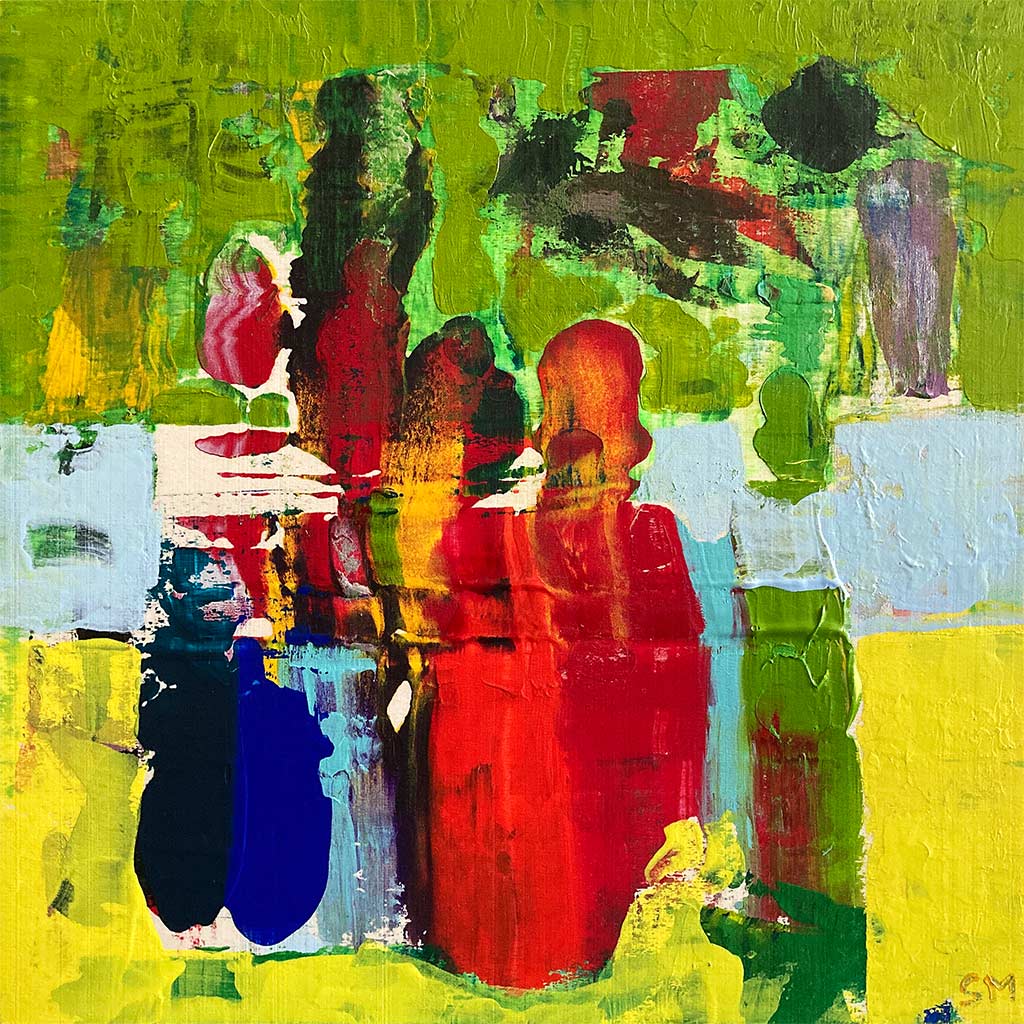
Conglomerate is an original abstract painting on cradled board by visual artist Shawn McNulty. This painting is is 1″ deep with pine edges, and ready to hang with wire on the back.
The Colorful Story of Conglomerate Rock
In the wide, creative world of geology, few rocks tell a more visually exciting story than conglomerate. It’s not a uniform block of stone or a sleek crystal — it’s a jumble, a mix, a celebration of variety. A conglomerate rock is like nature’s collage: rounded pebbles, sand, and gravel cemented together over time into one unified whole. When you find a piece of it, you’re looking at a snapshot of Earth’s busy history — rivers flowing, rocks breaking, sediments drifting, and time pressing everything into one colorful mass.
It’s easy to imagine that same energy in the vibrant abstract painting Conglomerate — a multicolored burst of red and orange rocky shapes bursting from a yellow and green backdrop. The painting captures the same sense of motion and diversity that defines the rock itself. Just like a real conglomerate, where many different stones come together to form something greater than their parts, Conglomerate the painting feels alive with contrast and cohesion — fiery fragments nestled in a bright, earthy field.
What Exactly Is Conglomerate Rock?
At its core, a conglomerate is a sedimentary rock, meaning it forms from particles — bits and pieces of older rocks that have been eroded, transported, and then deposited somewhere new. Over time, layers of these sediments pile up, and minerals dissolved in water fill in the gaps, binding everything together.
The key ingredient that makes a rock a conglomerate is the clast, which is just a fancy geological word for the little stones or pebbles embedded within. In conglomerates, these clasts are rounded, meaning they’ve been rolled around by water long enough to lose their sharp edges. If you could slice one open, you’d see a patchwork of colors — gray, pink, brown, red, even green — each fragment once part of a different parent rock.
You can almost see that same variety in the painting Conglomerate: the reds and oranges are like the rounded stones themselves, compacted and glowing with ancient heat, while the yellow and green background suggests the sandy matrix holding it all together. The whole canvas feels as if it’s been shaped by the same forces — motion, pressure, and time.
Born from Rivers and Beaches
Most conglomerates are born in energetic environments — places where water has the power to move big chunks of material. Think fast-flowing rivers, rocky shorelines, or the base of mountain streams. As the water rushes, it carries pebbles and gravel downstream, tumbling them over and over until they’re smooth and rounded. When the current slows down — say, when a river empties into a lake or ocean — the heavier material settles first. That’s where conglomerates begin their story.
Over thousands, even millions, of years, layers of these sediments accumulate. Then, as more and more material builds up, pressure increases, squeezing the lower layers and fusing the grains together. The result is a strong, chunky rock full of rounded stones that look as though they were plucked from a riverbed and frozen in place.
In Conglomerate the painting, you can almost feel that motion — those reds and oranges bursting outward, as if the stones themselves were tumbling through a current. The yellow and green tones provide the sense of the riverbed — earthy, fluid, and alive with movement. It’s a perfect visual metaphor for the dynamic origins of the rock.
A Rock That Tells Stories
Every pebble in a conglomerate has a history. Some may have come from granite mountains miles away, others from volcanic outcrops or sandstone cliffs. Each fragment carries its own mineral fingerprint — quartz shining like glass, basalt dark and heavy, or limestone worn smooth. When they come together, they tell a collective story of erosion, transport, and time.
If you hold a conglomerate rock in your hand, you’re holding a mini time capsule of landscapes that once were. You can trace rivers that no longer flow, mountains that have long since eroded away, and climates that existed millions of years ago. It’s geology’s version of a mosaic — a beautiful reminder that the Earth is always recycling itself.
That same storytelling quality shows up in Conglomerate. The bursts of color seem to represent fragments of different places and times — fiery reds like desert rock, oranges like rusted iron, all surrounded by the mellow greens and yellows of nature’s background. Together, they form a composition that feels both ancient and immediate, full of energy yet solidly grounded.
Texture and Character
One of the things that makes conglomerate rock so distinctive is its texture. Unlike smooth sandstone or fine-grained shale, conglomerate is rough and uneven, with clasts sticking out at all angles. Some are as small as a pea; others can be as large as a baseball. The spaces between them are filled with finer material called matrix — often sand or clay — which cements everything together.
That mix of roughness and cohesion is exactly what gives conglomerate its charm. It’s messy, yet unified. It’s a rock that refuses to be simple. That’s what Conglomerate the painting captures so well — a visual equivalent of geological texture. The rough, rocky bursts of red and orange stand out boldly, yet the yellow and green field ties them all together, softening the chaos into harmony.
More Than Just a Rock
Beyond its geology, conglomerate carries a deeper metaphor. It’s a reminder that beauty can come from combination — from pieces that are different finding strength in unity. Nature doesn’t shy away from mixing things up; it embraces the unpredictable, and that’s what makes conglomerate so fascinating.
In art, too, it’s the mix that makes things vibrant. The painting Conglomerate celebrates that same principle — color fragments colliding, contrasting, and eventually belonging. It’s a visual symphony of individuality and connection, echoing the way Earth’s processes naturally weave together diversity and cohesion.
A Burst of Earth’s Creativity
When you look at a piece of conglomerate rock, you’re seeing a record of energy — rivers rushing, stones colliding, sediments settling. It’s the Earth’s version of abstract expressionism. And when you look at Conglomerate the painting, you feel that same energy translated into color and motion. The reds and oranges explode like molten rock frozen mid-burst, while the greens and yellows hum with the quiet rhythm of life that surrounds it.
Both the rock and the painting are testaments to time, texture, and transformation — proof that even the most chaotic elements can come together to form something whole, radiant, and deeply alive. In geology and in art, that’s the essence of a conglomerate: a natural masterpiece made from many pieces, bound by pressure, patience, and the unstoppable creativity of the Earth itself.







Reviews
There are no reviews yet.